

There are three species of Mantids in the United States, but the two most commonly found on Long Island are the Chinese Mantis, Tenodera aridifolia sinensis, and the European or “Praying” Mantis, Mantis religiosa. The third species, the Carolina Mantis, Stagmomantis carolina is the only species native to the United States, but is not commonly found in New York.
There are many tales and myths which feature this curious insect. In Greek, the word “Mantis” means seer, and “Mantid” means diviner. Their folded forearms seem to recall a person in prayer, and have influenced how people see them across the world. In some cultures it is said that a Mantis will point lost children in the direction of their homes, and in China it is thought to have inspired the basic principles of Kung Fu.
The Chinese and European Mantids were introduced to the United States in the late 19![Praying_Mantis_Male_European-38[1]](https://quoguewildliferefuge.org/wp-content/uploads/Praying_Mantis_Male_European-381-e1432732205402.jpg) th century, most likely as a form of pest control. A gardener’s friend, they are noted for their extreme appetites and spend most of their time camouflaged and motionless waiting for insects to wander into their reach. Adult Mantids are always hungry and tend to eat large insects, but have been reported to eat small lizards, scorpions and even birds! They have even been known to eat each other! Although Mantids are commonly thought of as beneficial, their voracious appetite means that they are as likely to eat a pest as they are to eat beneficial insects.
th century, most likely as a form of pest control. A gardener’s friend, they are noted for their extreme appetites and spend most of their time camouflaged and motionless waiting for insects to wander into their reach. Adult Mantids are always hungry and tend to eat large insects, but have been reported to eat small lizards, scorpions and even birds! They have even been known to eat each other! Although Mantids are commonly thought of as beneficial, their voracious appetite means that they are as likely to eat a pest as they are to eat beneficial insects.
Mantids belong to the class Insecta, which means they are 6 legged and have three distinct body segments, a head, thorax and abdomen. They vary in color from a light green to a mottled grey/brown, and range from about 2 to 5 inches in size. Mantids have several unique characteristics. Unlike most insects they are able to rotate their heads 180 degrees. They are the only insects that can see in three dimensions (like humans), and can see up to 60 feet away! They are often seen holding their forelimbs in a “praying” stance, which allows them to quickly extend their strong, spiked arms to grab and hold prey. These insects are so fierce that the females are famous for beheading males during mating!
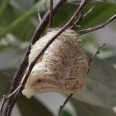 Females tend to grow larger than males. They lay their eggs in the autumn in a structure called an ‘ootheca’, which they often attach to low lying branches or bushes. Each ootheca may contain hundreds of eggs! When nymphs emerge in the spring they are wingless, and less than ¼ inch long. Mantis nymphs are ‘precision’ jumpers, and use their uncanny sense of direction to intercept prey midair! Less than 10% of mantis nymphs survive to adulthood, in part because their diminutive size makes them an easy meal for other insects and birds.
Keep an eye out for Mantises in your backyard this summer!
by Kimberly Stever